Article -> Article Details
| Title | Form 1041 Preparation for CPA Firms: Streamline Trust Tax Workflows |
|---|---|
| Category | Business --> Accounting |
| Meta Keywords | tax return preparation for CPA firms, Offshore Tax Preparation & Compliance Services, Form 1041 preparation |
| Owner | Unison Globus |
| Description | |
| A trust or estate file can get marked ‘pending’ for a familiar set of workflow reasons. A brokerage statement is incomplete, a beneficiary detail needs confirmation, or fiduciary accounting records have not arrived. The preparer moves to the next return with the intention of returning to the file later. Then 1040 volume increases, review queues fill, and that pending file remains untouched longer than planned. For firms managing tax return preparation for CPA firms, this recurring habit creates more than an internal scheduling issue. Delayed fiduciary work can compress the available review window, extend open client questions, complicate beneficiary reporting, and increase workload pressure as deadlines approach. The challenge is that Form 1041 preparation depends on several interconnected inputs, making unresolved issues more likely to create downstream rework. The IRS requires Form 1041 to report an estate or trust’s income, deductions, gains, losses, distributions, and tax liability. For a calendar-year estate or trust, the return is generally due April 15, and Form 7004 can be used to request an automatic 5½-month extension when the applicable requirements are met. Client expectations make the operational issue more significant. Thomson Reuters’ 2023 State of the Tax Professionals Report found that more than 93% of respondents said clients were seeking some form of advisory service, while close to 65% described that demand as strong. The implication is clear: firms need a workflow that keeps preparation moving while preserving the professional judgment fiduciary engagements require. A standardized process is intended to give partners more room to focus on technical judgment, client communication, and other higher-value work instead of repeatedly resolving preventable preparation issues. TL;DR: Key TakeawaysForm 1041 engagements tend to slow down at predictable points: incomplete documentation, fiduciary accounting-to-tax reconciliation, DNI and beneficiary allocations, competing 1040 workloads, and state filing considerations. A more reliable workflow establishes clear controls before preparation begins:
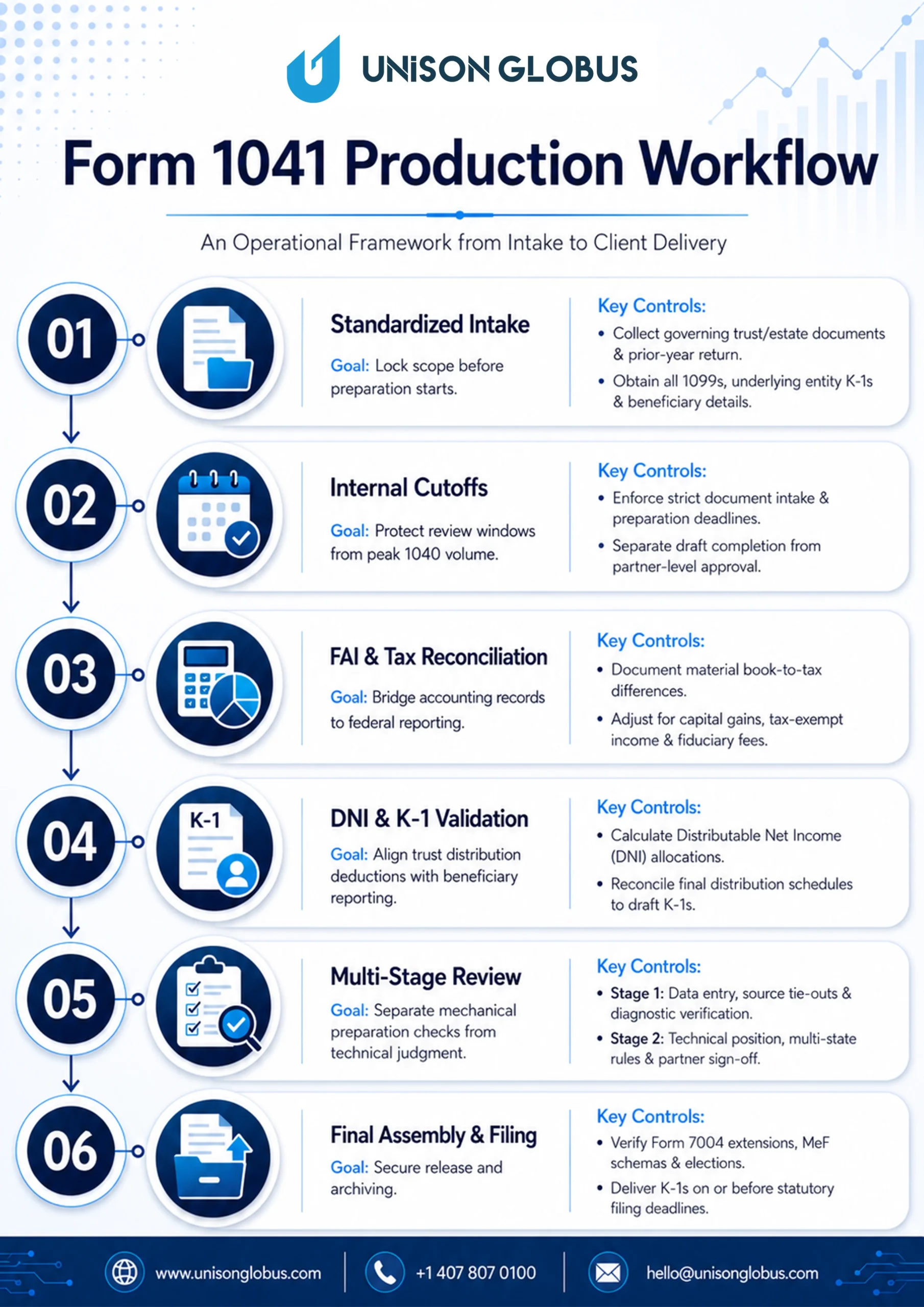
A checklist creates consistency, but reliable Form 1041 delivery also requires sufficient preparation capacity and clear ownership throughout the workflow. Why Form 1041 Engagements Break Down at the Same Points Every YearForm 1041 preparation challenges tend to emerge where fiduciary accounting, tax treatment, beneficiary reporting, and incomplete information intersect. The following are the recurring pressure points that can turn a manageable preparation issue into rework, review delays, or a pending file. FAI vs. Taxable IncomeFiduciary accounting income and federal taxable income are distinct measurements, with fiduciary accounting treatment determined under the governing instrument and applicable state law, and federal tax treatment determined under federal tax rules. The tax return therefore requires more than importing accounting balances. Preparers need a documented reconciliation between the fiduciary accounting records and the federal tax calculation. This becomes particularly important when capital gains, tax-exempt income, fiduciary expenses, distributions, and other items receive different treatment for accounting and tax purposes. Clarification: Review the governing instrument and applicable state law for fiduciary accounting treatment, then apply the applicable federal tax rules when preparing Form 1041. DNI and Beneficiary AllocationsDistributable net income affects how certain distributions are reflected between the state or trust and its beneficiaries. The IRS instructions distinguish between income required to be distributed currently and other amounts paid, credited, or required to be distributed. Beneficiaries generally include the portion of DNI properly allocated to them under the applicable distribution and tax rules. That makes the DNI calculation and Schedule K-1 preparation a connected review point rather than two separate tasks. A disciplined workflow should reconcile the distribution calculations to the final K-1s before the return reaches partner review. Incomplete DocumentsFiduciary returns depend heavily on information outside the tax software. Common gaps include brokerage statements, corrected Forms 1099, K-1s from underlying entities, fiduciary accounting records, distribution details, prior-year workpapers, and governing-document information. When those items arrive after preparation has started, the file often requires rework. A standardized intake process moves the issue upstream, where it is easier to resolve. Form 1041 Work Competing With 1040 VolumeFiduciary returns often compete for the same preparers and reviewers handling individual, partnership, S corporation, and corporate engagements. The result is predictable. High-volume work receives immediate production attention while lower-volume fiduciary files remain in pending status. The problem is not simply the number of Form 1041 tax returns. It is the concentration of specialized preparation and review work around the same periods. Multi-State ConsiderationsState filing considerations should be identified during intake, not discovered during final review. The engagement file should capture relevant fiduciary connections, income sources, property locations, beneficiary information, and state-specific filing considerations. Federal Form 1041 instructions can also change independently of state filing requirements. For 2025, the IRS revised the State and Local Tax Deduction Worksheet, including changes affecting estates and trusts with adjusted gross income above $500,000. Warning: State fiduciary filing analysis should not be reduced to beneficiary residency alone; the applicable state rules and the estate or trust’s specific facts determine the filing position. A Practical Form 1041 Workflow for CPA FirmsA strong Form 1041 tax return preparation process turns recurring review questions into defined checkpoints, with each checkpoint assigned an owner, required inputs, and a clear completion standard. Standardize Document IntakeUse a fiduciary-specific intake list before assigning the engagement to preparation:
Establish Internal CutoffsThe statutory deadline should not become the firm’s internal production deadline. For the 2025 tax year, calendar-year estates and trusts must file Form 1041 by April 15, 2026. Form 7004 can be used to apply for an automatic 5½-month extension for an estate other than a bankruptcy estate or a trust filing Form 1041, subject to the applicable requirements. For firms, the important distinction is between the IRS deadline and the internal operating calendar:
Validate Accounting and Tax DataReconcile the accounting information before relying on it for the return:
The objective is a documented bridge from source records to the tax return, not simply a balanced accounting file. Standardize Beneficiary Reporting and State Filing ReviewBeneficiary reporting deserves its own review step because the output directly affects the beneficiary’s tax reporting.
The IRS states that Schedule K-1 reports each beneficiary’s share of income, deductions, credits, and other relevant items from an estate or trust. Apply Multi-Stage ReviewTwo-stage review separates preparation accuracy from professional judgment.
This creates a return that is review-ready rather than merely prepared. Complete Filing and Documentation ChecksThe final checkpoint should confirm that the return and engagement file are complete:
The IRS instructions state that Schedule K-1 must be provided to each beneficiary who receives a distribution of property or an allocation of an item from the estate or trust on or before the date Form 1041 is required to be filed.
Why the Checklist Alone Does Not Solve the Capacity ProblemOnce workflow controls are established, the remaining constraint is whether the firm has sufficient preparation and review capacity to execute them consistently. When fiduciary work competes with 1040s and other entity returns, that capacity constraint becomes most visible in preparation and review queues. Four pressure points usually emerge:
This is why CPA firm tax preparation should be considered as an operating model, not simply a collection of individual return-preparation tasks. The firm’s objective should be to reserve professional judgment for the work that requires it while creating a controlled path for repeatable preparation activities. Read also: Outsourcing Tax Preparation to India: A Guide for US CPA Firms Where Technology and External Support FitTechnology can improve visibility, document control, and data movement across a Form 1041 workflow. External preparation support can address defined execution gaps when internal preparation or review capacity is constrained. Neither replaces the CPA firm’s professional judgment or responsibility. Accounting Systems and Tax Data FlowQuickBooks, Xero, and NetSuite may serve as accounting systems of record depending on the client’s environment. For fiduciary engagements, the important control is how accounting records move into tax workpapers and ultimately support the Form 1041 tax return. A practical workflow should be established:
The accounting platform should support the tax workflow, not substitute for the reconciliation and tax analysis required to prepare the return. Tax Software IntegrationProfessional tax software supports return preparation, calculations, diagnostics, and filing workflows. Any internal or external preparation team should work within the firm’s approved tax application and access model or follow a controlled transfer process. For Form 1041 engagements, integration should preserve the connection between source documents, workpapers, supporting schedules, the draft return, and review comments. The IRS maintains Modernized e-File (MeF) schemas and business rules for Form 1041, with tax-year-specific release versions and testing requirements. For 2026, the IRS lists multiple Form 1041 MeF release versions and notes that schemas and business rules are distributed through the registered user portal and e-Services mailbox. Practical implication: Firms should confirm that their tax software and preparation workflow align with the applicable Form 1041 MeF schema, business rules, and production version before filing. Secure Document ExchangeFiduciary preparation depends on sensitive financial, beneficiary, and tax information. Document exchange should therefore take place through the firm’s approved secure environment or an appropriately controlled platform. The workflow should address:
Security controls should be evaluated as part of the overall operating model rather than treated as a separate technology feature. Workflow TrackingA defined status model gives the firm visibility into where each fiduciary engagement stands and where preparation or review is accumulating. A practical Form 1041 workflow can use stages such as:
This makes bottlenecks visible before they become compressed review windows. What Can Be Supported ExternallyTechnology can organize the workflow, while defined external preparation support can address specific execution activities within the firm’s controls. Depending on the engagement scope and the firm’s controls, tax preparation support for CPA firms can include:
Depending on scope, the same model can support trust and estate tax preparation when the external team has the appropriate technical expertise, defined responsibilities, and documented review procedures. What Should Remain With the CPA/PartnerExternal preparation should not blur the distinction between execution support and professional responsibility. The CPA firm should retain ownership of:
Disclaimer: External preparation support adds execution capacity. It does not transfer the CPA firm’s professional judgment, client responsibility, or final responsibility for the return. Evaluating an External Preparation ProviderWhen evaluating options to hire offshore tax preparers, firms should assess whether the provider can operate within the firm’s existing Form 1041 workflow rather than simply provide additional preparer hours. Key evaluation points include:
For tax return information, firms should also evaluate applicable requirements under IRC § 7216. The IRS states that § 7216 restricts tax return preparers from knowingly or recklessly disclosing or using tax return information for unauthorized purposes, subject to applicable consent requirements and regulatory exceptions. The right operating model connects Form 1041 preparation technology, defined preparation responsibilities, and firm-level review controls. The result is a workflow in which technology improves visibility, external support handles agreed preparation activities, and the CPA retains professional judgment. This blog was originally posted here: https://unisonglobus.com/form-1041-preparation-challenges-cpa-firms/ | |