Article -> Article Details
| Title | GCP Audit and Inspection Readiness Services |
|---|---|
| Category | Business --> Healthcare |
| Meta Keywords | GCP monitoring services |
| Owner | Zenovel: Pharma & Clinical Research Solutions |
| Description | |
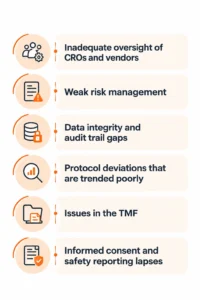
Where Inspection Findings Really Come FromInspection outcomes from the FDA, EMA, MHRA, PMDA, and other authorities reveal that significant findings are often indicative of systemic issues in sponsor oversight rather than isolated site errors. Figure 1: Inspection Findings—Zenovel
GCP Audit and Inspection Readiness: From Periodic Audits to Continuous ReadinessThe traditional model of scheduled audits leaves gaps where issues can go unnoticed. A more effective approach regards readiness as ongoing, supported by four key elements. Risk-based audit strategyAudit plans should prioritize quantitative and qualitative risk indicators over fixed site percentages. Key inputs include risk indicators from central monitoring, enrollment velocity, screen failure patterns, query aging, data-entry lag, unusual data distributions, and trends in deviations by site and vendor. The audit plan must adapt to changing signals, with documented rationale for defensibility during inspections. Vendor and system auditsQualification questionnaires indicate a vendor’s quality system but do not verify its effectiveness. A successful program includes both for-cause and routine audits, oversight of subcontractors, validation of computerized systems, and assessment of the vendor’s CAPA management. Audits for technology providers should focus on access control, change management, audit trail practices, and the integrity of data transfer throughout the process. TMF healthTMF completeness, timeliness, and quality must be continuously monitored with set thresholds and escalation procedures. Sponsors should provide contemporaneous filings rather than retrospective clean-up. When responsibilities are divided between the sponsor and CRO, the reconciliation process and ownership of gaps should be clearly defined. CAPAInspectors scrutinize CAPA records, noting pitfalls such as weak root cause analysis, corrective actions limited to retraining, and unperformed effectiveness checks. An effective CAPA process is connected to trend analysis, ensuring that recurring findings provoke systemic actions across sites or studies.
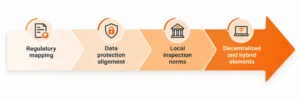
Managing Compliance Across JurisdictionsFigure 2: Programs that perform well tend to handle jurisdictional variation deliberately:
A single global protocol must consider various local realities by implementing key strategies: maintaining a regulatory mapping matrix of local requirements, ensuring data protection compliance for cross-border transfers, adapting to local inspection norms, and defining responsibilities for decentralized and hybrid elements like telemedicine and remote consent. These measures help mitigate friction across jurisdictional variations.
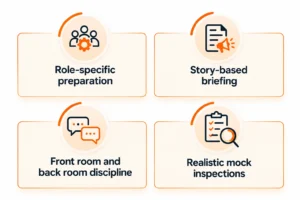
Well-organized records can still be undermined by an unprepared team. GCP audit and inspection readiness should include Figure 3: Inspection readiness records—Zenovel
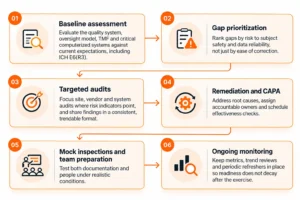
A Practical Readiness RoadmapFigure 4: Inspection Readiness- Zenovel
Zenovel aids pharmaceutical and biotech sponsors in GCP audit and inspection readiness activities, bridging quality strategy and daily trial execution. Support varies based on program needs.
This aims to provide sponsors with a clear and defensible overview of their compliance status across different regions, along with actionable recommendations. The inspection readiness reflects daily quality management practices. Organizations that focus on risk-based oversight, vendor accountability, data integrity, and team preparation are more confident and resilient during inspections. In an environment of increasing global trials and changing regulatory demands, continuous readiness is deemed the best strategy for achieving compliance.
To discuss how Zenovel can support your GCP audit and inspection readiness program, get in touch with our team. | |